


Table of Contents
- How Floral Arrangement Pricing Works
- The Cost Foundation: Wholesale Costs and Markup
- Factors Affecting Flower Prices
- Labor, Design Fees, and Overhead
- Average Cost of Floral Arrangements
- Is Flower Subscription Service Worth It for Homes
- Setting Your Own Pricing Strategy
- Frequently Asked Questions
Last Updated: September 23, 2026
How Floral Arrangement Pricing Works
Floral arrangement pricing reflects wholesale costs, labor, design expertise, overhead, and market conditions. At Brampton Florist, we calculate the true cost of materials, skilled design work, and apply a sustainable profit margin to serve your community year-round.
A florist calculates retail price by adding labor, design fees, and overhead to wholesale costs, then applies a markup percentage. Complexity arises from seasonal availability, specialty flowers, and occasion type, daily arrangements and wedding orders follow different pricing logic.
The Cost Foundation: Wholesale Costs and Markup
Floral arrangement pricing begins with wholesale cost. A florist purchases flowers at a fraction of retail price, then applies markup to cover labor, overhead, and profit.
Markup varies depending on arrangement type and market conditions.
Most florists lose a percentage of inventory to waste: stems that don’t meet standards, wilted flowers, browned foliage, and design trimmings. This makes the true cost per usable stem significantly higher than the wholesale invoice.
Calculate waste rate by dividing total wholesale cost purchased by stems actually used in arrangements. If you purchase flowers and use a portion in finished work, your shrinkage rate means true cost of goods sold is higher than invoiced. Ignoring this can lead to underpricing.
Formula: (Wholesale cost ÷ (1 − Shrinkage rate)) + Labor cost + Overhead allocation = True cost. With shrinkage, wholesale cost becomes higher in true material cost before labor and overhead.
Most florists multiply true cost to reach retail price, accounting for labor, overhead, and profit. This shifts based on seasonal availability and design complexity.
Seasonal demand affects waste rates: peak periods see waste drop, while slow periods climb. Tracking waste by season helps adjust pricing dynamically and identify inefficiencies.
Factors Affecting Flower Prices
Seasonal Availability and Market Demand
Seasonal availability powerfully drives floral arrangement pricing. In-season flowers have lower wholesale costs due to abundant supply; out-of-season flowers sourced from distant regions cost significantly more.
Roses in February cost more than in June due to demand and limited supply. Peonies in December require imports, driving costs higher than late spring when locally abundant.
Seasonal demand creates scarcity pricing: when everyone wants the same flowers simultaneously, wholesalers raise prices. A June wedding with garden roses costs less than a December wedding with identical flowers.
Specialty Flowers and Sourcing
Specialty flowers command premiums due to sourcing difficulty and special handling. Ranunculus requires careful conditioning, orchids are expensive to import, and unusual varieties like protea cost significantly more at wholesale than standard carnations.
Specialty flower wholesale costs reflect rarity, distance traveled, and fragility. Florists pay for handling expertise, proper storage, and the risk of loss during transport, all factored into retail price.
Labor, Design Fees, and Overhead
Labor cost reflects a florist’s true value. A simple five-stem arrangement takes 10-15 minutes; a bridal bouquet or event installation takes hours of skilled design work.
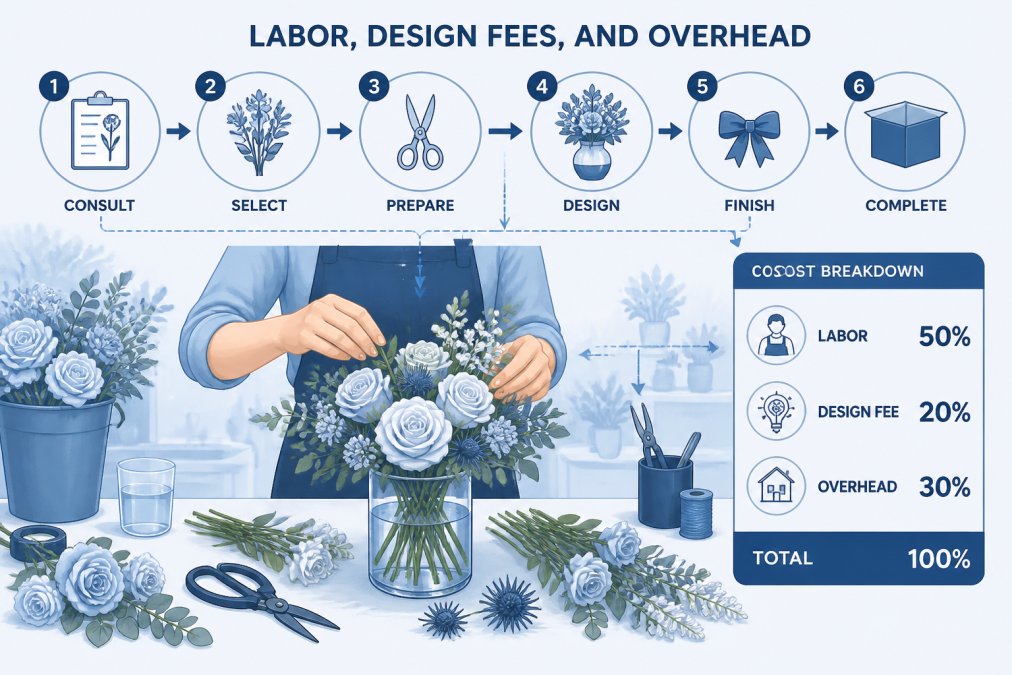
Labor cost covers the designer’s hourly rate, training, and experience. Senior designers command higher labor costs than entry-level designers, reflected in final pricing.
Design fees are sometimes charged separately, especially for custom work or event orders. A wedding consultation, custom color palette development, and design direction carry their own fees beyond the cost of materials. This is standard practice because the design phase requires expertise and time before a single flower is even ordered.
Overhead expenses, rent, utilities, insurance, equipment, waste management, are distributed across every arrangement a florist sells. A busy shop spreads these costs across more orders, while a slower shop must charge more per arrangement to cover the same overhead. This is why pricing varies between florists, even in the same area.
Order Online or Call Now to Order Flowers →
Average Cost of Floral Arrangements
Daily Arrangements vs. Event Orders
A daily arrangement, the kind you order for a birthday, get-well, or “just because” moment, typically costs less than an event order because the design work is more straightforward and the timeline is flexible. A florist can batch daily arrangements, sourcing flowers efficiently and creating designs that work with what’s in stock.
Event orders operate under entirely different constraints. A wedding requires specific flowers in specific colors, delivered on a specific date, often with multiple pieces (bridal bouquet, bridesmaids’ bouquets, centerpieces, ceremony installations). The florist can’t substitute a similar flower if the requested variety is unavailable, they must source exactly what the client wants.
This is why a single bridal bouquet costs significantly more than a daily arrangement of similar size. The labor cost is higher because custom design work is involved. The sourcing cost is higher because the florist may need to special-order flowers. The overall floral arrangement pricing reflects the complexity and specificity of the order.
For a wedding, the cost of floral arrangements scales with the scope: a small intimate ceremony with just a bridal bouquet and a few centerpieces costs less than a large reception with ceremony installations, multiple bouquets, and elaborate table arrangements. But per-piece, wedding flowers often carry a premium because of the custom design work and the client’s higher expectations.
Is Flower Subscription Service Worth It for Homes
A flower subscription service delivers fresh arrangements to your home on a regular schedule, typically weekly or bi-weekly. The value proposition depends on whether you consistently use fresh flowers and whether the subscription pricing aligns with what you’d otherwise spend buying arrangements individually.
A subscription service usually offers a lower per-arrangement cost than ordering individual arrangements, because the florist can plan inventory more efficiently and batch design work. However, you’re committing to a regular delivery schedule, which means paying for flowers even in weeks when you might not have chosen to buy them.
For a household that loves fresh flowers and uses them year-round, a subscription can deliver genuine value. You’re getting consistent access to seasonal flowers at a predictable cost, and the convenience of delivery is worth the premium. For someone who buys flowers occasionally and prefers to choose arrangements based on mood or occasion, a subscription may not justify the commitment.
The real question is whether the subscription price, based on arrangement size and frequency, matches your actual spending on flowers. Many households overestimate how much they’d spend on flowers without a subscription, making the service feel expensive. Others find that having fresh flowers delivered regularly changes their habits and makes the subscription worthwhile.
Setting Your Own Pricing Strategy
If you’re a florist setting prices, the foundation is calculating your true cost of goods sold (including waste), determining the labor hours required for each type of arrangement, and allocating overhead. From there, apply a markup percentage that covers overhead and delivers a sustainable profit margin.
Start with your wholesale costs for the most common flowers you use. Track your labor hours for different arrangement types, a simple hand-tied bouquet versus a complex wedding centerpiece. Calculate your monthly overhead (rent, utilities, insurance, equipment, waste management) and divide it by the number of arrangements you typically create each month. This gives you the overhead cost per arrangement.
The Psychology of Price Presentation
- Lead with the design expertise and customization, not the flowers. “I’m creating a custom arrangement tailored to your color palette and occasion” signals value before price is mentioned.
- Explain the freshness guarantee. Highlighting the longevity of fresh flowers justifies a premium over grocery store arrangements.
- Highlight the labor and skill. “This bridal bouquet takes 45 minutes of hand-design work by our senior designer” contextualizes why it costs more than a simple vase arrangement.
- Use tiered pricing to anchor perception. Offering a “Classic,” “Premium,” and “Luxury” option makes the middle tier feel like the natural choice and makes your standard pricing feel reasonable by comparison.
- Provide price ranges early. “Custom wedding florals typically range from $800 to $2,500 depending on guest count and design complexity” sets expectations before a client invests emotional energy in a vision you can’t deliver at their budget.
Handling Price Objections
- “I understand that’s more than you expected. The difference between our pricing and a grocery store arrangement is that we hand-select every stem for quality, design custom to your vision, and guarantee freshness. Would you like to see the difference in person?”
- “For a wedding, floral design is one of the most visible elements guests notice. Investing in quality arrangements ensures your event looks polished and memorable. Our pricing reflects the expertise and care that makes that possible.”
- Avoid justifying price by itemizing flowers (“three roses at $2 each…”). This trains clients to shop by stem count, not design quality. Instead, justify by outcome: “This arrangement creates the exact mood you described, romantic, garden-style, with movement and texture.”
Dynamic Pricing for Different Order Types
Communicating Value Builds Loyalty
Frequently Asked Questions
What is the average cost of a floral arrangement?
The average cost of floral arrangements varies widely based on size, flower type, complexity, and occasion. Daily arrangements typically range from modest to mid-range pricing, while wedding or event arrangements cost significantly more due to scale and labor intensity. Seasonal availability, specialty flower selection, and delivery fees also affect final cost. For current pricing on arrangements suited to your occasion, contact a local florist directly to discuss your budget and needs.
How do florists calculate the price of a custom arrangement?
Florists calculate pricing by combining wholesale cost of flowers and hardgoods, labor and design time, overhead expenses, and desired profit margin. A common industry approach multiplies the cost of goods sold by a markup percentage to determine retail price. Custom arrangements command higher prices due to additional design consultation, specialized mechanics, and time investment. The final price reflects material costs, designer expertise, and business operational expenses.
What factors influence the cost of fresh-cut flowers?
Key factors include seasonal availability (out-of-season flowers cost more), specialty varieties requiring special sourcing, flower freshness and quality grade, perishable inventory shrinkage, and market demand. Local sourcing versus imported flowers affects wholesale cost. Event timing, such as Valentine’s Day or weddings during peak season, increases prices due to high demand and limited supply. Container and vase costs, plus floral mechanics and design complexity, also contribute to the final retail price.
Why should I order from a local florist instead of a large delivery website?
Local florists like Brampton Florist hand-craft arrangements with fresh flowers sourced for quality and longevity. You receive direct access to design expertise, personalized consultation, and reliable same-day delivery for urgent needs. Local florists understand their community’s preferences and can offer culturally-specific arrangements. You support a family-owned business invested in your satisfaction, not a third-party platform taking a commission. Fresh arrangements created in-house typically arrive in better condition than pre-made designs shipped long distances.


