


Table of Contents
- What Custom Floral Arrangements for Events Actually Include
- How to Choose Event Flowers That Match Your Theme
- Floral Arrangement Budget Planning: What Drives the Cost
- Corporate Event Floral Centerpiece Ideas That Work
- Sustainable and Eco-Friendly Floral Practices
- Maintenance Tips to Keep Arrangements Fresh Longer
- 2026 Floral Design Trends for Events
- Frequently Asked Questions
Last Updated: September 11, 2026
What Custom Floral Arrangements for Events Actually Include
Custom floral arrangements for events are designed floral pieces built to a specific brief, venue, and colour palette rather than pulled from a standard catalogue. This guide from Brampton Florist covers what they include, how to plan them, and what drives the cost. We build every event order by hand, from a single centerpiece to a full ceremony and reception setup.
A complete event floral package usually covers more ground than most people expect. It spans bridal bouquets and boutonnieres, ceremony flowers, reception centerpieces, and larger floral installations that anchor a room. The Canadian Food Inspection Agency guidance on cut flowers and plant imports is worth knowing if you plan to bring in specialty blooms from abroad, since some varieties carry import conditions.
The arrangements are only half the job. Delivery windows, on-site setup, and breakdown matter just as much to how the day runs.
A full-service event florist handles design, sourcing, delivery, setup, and takedown. If a quote only covers the flowers, ask who is installing them and when.
How to Choose Event Flowers That Match Your Theme
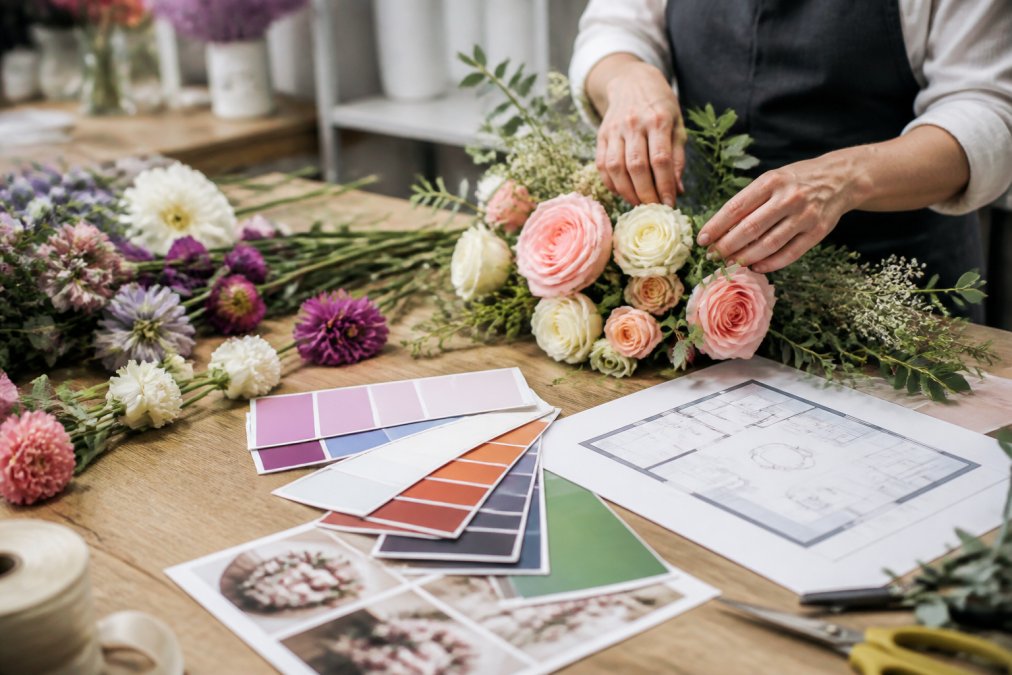
Matching event flowers to a theme starts with the venue, not a mood board. The room’s architecture, lighting, and existing colour scheme set the constraints that make a palette work or fight itself.
Start With the Venue, Not the Flowers
Walk the space before you pick a single stem. A low-ceiling hall with warm wood panelling calls for different shapes than a glass atrium with white walls. Tall arrangements that look dramatic in a ballroom can block sightlines in a smaller room. Note where guests enter, where they sit, and where the photographs will be taken. Those three spots usually deserve the most floral attention.
Colour Palette and Seasonal Blooms
A tight colour palette of two or three tones reads as intentional; five tones read as accidental. Seasonal blooms keep both the look and the budget grounded, since out-of-season flowers carry a premium and often arrive less fresh. In a Canadian climate, late spring and summer open the widest local selection, while winter pushes you toward imports. Ask your florist which stems are at their best during your event month.
Floral Arrangement Budget Planning: What Drives the Cost
Floral arrangement budget planning comes down to four variables: stem count, stem type, labour, and logistics. Each moves the total independently, which is why two events with the same guest count can land far apart.
Here is how each factor typically affects a quote:
| Cost Driver | What Pushes It Up | How to Keep It Down |
|---|---|---|
| Stem type | Imported or out-of-season blooms | Choose in-season, regionally available flowers |
| Stem count | Large, dense arrangements | Mix focal blooms with fuller, lower-cost greenery |
| Labour | Complex installations and wiring | Reuse ceremony pieces at the reception |
| Logistics | Multiple venues or tight delivery windows | Consolidate to one venue and one delivery slot |
Breaking Down Your Floral Budget by Event Section
Most planners treat the floral budget as a single line item. In reality it splits across three areas, and allocating proportionally prevents overspending in one category at the expense of another.
Ceremony flowers typically consume 20-30% of the budget, covering the arch or backdrop, aisle arrangements, and the bridal bouquet (theknot.com). They are the most visible in photographs, so they warrant investment, but they can be repurposed at the reception to stretch the budget further.
Reception centerpieces usually take 40-50% of the budget, and guest count directly drives cost: a 100-person event with centerpieces on every table (roughly 10-12 tables) requires more stems and labour than a 50-person event (brides.com). Low, wide arrangements cost less than tall installations because they use fewer stems and less structural support.
Installations and décor (entrance arrangements, gift table flowers, cocktail-hour installations) account for 15-25%. They are often the first impression and the last memory, but can be simplified to free up budget for centerpieces.
Guest Count and Per-Head Floral Allocation
A practical rule of thumb for floral allocation:
These ranges assume in-season, regionally available blooms and standard labour. Winter events, imported flowers, or complex installations push costs higher, while monochromatic palettes, greenery-heavy designs, and reused ceremony pieces bring them down.
Timing and Seasonal Premiums
Booking your florist ahead allows the designer to source blooms in advance and batch orders with other events; last-minute bookings may incur a rush fee. Late spring through early autumn offers the widest local selection, while winter events and holidays may carry a premium.
Booking a venue before checking its setup rules can cost you. Some spaces restrict open flames, hanging points, or delivery hours, which rules out certain installations entirely.
Getting an Accurate Quote
Pricing depends on quantity, dates, and delivery, so ask for a written quote rather than a rough guess. A common mistake is setting the floral budget last, after the venue and catering are locked, by then the room’s constraints have already decided half your costs. When requesting a quote, provide:
- Event date and season
- Guest count and table count
- Venue dimensions and ceiling height
- Colour palette or theme
- Which elements you need (ceremony, centerpieces, installations, bouquets)
- Whether you want to reuse ceremony flowers at the reception
- Any sustainability preferences (locally sourced, foam-free, etc.)
A florist who asks these questions before quoting is more likely to deliver a realistic price and a design that fits your space and budget.
Corporate Event Floral Centerpiece Ideas That Work
Corporate event floral centerpiece ideas should stay low, neutral, and easy to move. Guests need to see the person across the table, so height is the enemy. The arrangement should also withstand a 4-6 hour event without wilting, handle being moved during setup, and complement your brand colours without screaming for attention.
Low, Wide Arrangements in Brand-Adjacent Colour
A single-colour or two-colour palette in a low, wide vase (typically 4-6 inches tall) is the safest corporate choice. It mixes focal blooms (roses, peonies, or dahlias) with filler greenery to create volume without height, sitting flush with the table for clear sightlines.
Mechanics: Most florists use a shallow bowl or cube vase with floral foam (or a reusable pin holder for foam-free options) to anchor stems at angles. The arrangement looks finished from all sides, since guests walk around it during cocktail hour.
Durability: Lasts 6-8 hours without water top-ups if built the morning of the event. Ask your florist to deliver in a cool vehicle and keep them cool until 30 minutes before guests arrive.
Single-Stem Bud Vases in Clusters
Instead of one large arrangement per table, place 3-5 small bud vases (each holding a single stem or a tight trio) along the table runner. This creates visual interest without blocking sightlines and allows flexible placement.
Mechanics: Each bud vase holds 1-3 stems in minimal water, arranged in a line or scattered pattern along the table’s centre. This works well for long banquet tables where a single centerpiece would look lonely in the middle.
Durability: Bud vases dry out faster than larger arrangements. Ask your florist to deliver them with extra water and provide a small pitcher so staff can top them up mid-event.
Greenery-Only Runners for a Clean, Modern Look
A lush greenery runner (eucalyptus, ruscus, Italian ruscus, or mixed foliage) down the centre of the table, punctuated by candles or small potted plants, creates a garden-style aesthetic without the cost of blooms, ideal for tech companies, law firms, or minimalist brands.
Mechanics: The runner is built on a floral base (foam or chicken wire) and laid directly on the table, with candles or votives nestled into the greenery or small potted orchids placed at intervals.
Order Online or Call Now to Order Flowers →
Durability: Greenery lasts 8+ hours without water if the base is kept moist. Runners can be built the day before and stored in a cool room.
Potted Orchids That Double as Gifts
A single potted orchid (white, pink, or purple) on each table serves as both décor and a take-home gift, reducing waste and extending the perceived value of the floral investment.
Mechanics: The orchid arrives in a decorative pot and is placed on a small stand or directly on the table. Some florists add a care-instruction card to reinforce the gift aspect.
Durability: Orchids thrive for weeks with minimal care, making them ideal for events where guests will take them home.
Monochromatic Tablescapes That Photograph Well
A single hue, all white, all blush, all sage green, repeated across every table creates a cohesive, premium look that photographs well from any angle. This is especially effective for virtual or hybrid events where the camera captures the overall aesthetic.
Mechanics: All blooms, greenery, linens, and even candles are in the same colour family. The arrangement itself can be low and wide, a bud vase cluster, or a runner, the unity comes from colour, not form.
Cost: Varies by arrangement style.
Durability: Same as the underlying arrangement style.
Consistency and Brand Reinforcement
For corporate clients, consistency matters more than variety. Repeating the same centerpiece across every table looks deliberate and simplifies setup. If your company has a defined colour palette, share it early so the arrangements reinforce the brand rather than compete with it, a navy and white palette should see navy and white flowers, not rainbow variety.
Ask your florist to build one sample centerpiece before the full order. Seeing the actual scale and colour in your venue’s lighting prevents expensive surprises on the day. Request the sample 2-3 weeks before the event so there is time to adjust the design.
Sustainable and Eco-Friendly Floral Practices
Sustainable floral practices focus on where flowers come from, how they are packaged, and what happens to them after the event.
Practical steps include choosing seasonal, regionally grown blooms to cut transport emissions, skipping floral foam for reusable mechanics like chicken wire and pin holders, and donating post-event flowers to care homes or hospitals. Reusing ceremony arrangements at the reception is the simplest win, halving the pieces you need built. Raise sustainability during the consultation, because it changes sourcing decisions that are hard to reverse once the order is placed.
Maintenance Tips to Keep Arrangements Fresh Longer
Fresh arrangements last longer when the water stays clean and the stems stay cool. Most wilting traces back to bacteria in the vase, not the flowers.
A few habits that extend vase life:
- Re-cut stems at an angle every two days
- Change the water completely rather than topping it up
- Keep arrangements out of direct sun and away from heating vents
- Remove any foliage sitting below the waterline
- Store spare pieces in a cool room before the event
For a wedding or corporate function, ask your florist when the pieces will be built, arrangements assembled the morning of the event outperform ones made days ahead. If you handle delivery yourself, keep the car cool and transport arrangements upright.
2026 Floral Design Trends for Events
Event floral design in 2026 leans toward texture and restraint over volume. Instead of towering centerpieces, designers build arrangements with varied stem heights, dried elements mixed with fresh blooms, and heavier foliage for depth.
Other directions gaining ground include monochromatic palettes, asymmetric shapes that feel handcrafted rather than uniform, and installations that frame a space instead of filling it. Grounded, garden-style tablescapes continue to replace tightly packed, formal arrangements. The throughline is a move away from “more” toward “considered”, a smaller number of well-built pieces now reads as more premium than a room stuffed with flowers.
Ask your florist to build one sample centerpiece before the full order. Seeing the actual scale and colour in your venue’s lighting prevents expensive surprises on the day.
Planning an event means juggling a venue, a guest list, a budget, and a hundred small decisions. Floral design should not be the one that keeps you up at night. Brampton Florist is a family-owned, full-service florist open seven days a week, with expert designers who hand-craft every arrangement and same-day delivery when you order by 1 PM. Whether you need wedding florals, corporate centerpieces, or sympathy arrangements, our team handles design, delivery, and setup so the flowers simply work. Order online or call now to start your event consultation.
Frequently Asked Questions
What is the 3:5:8 rule for floral design?
The 3:5:8 rule is a proportion guide for arranging flowers. It means the height of the arrangement should relate to the container in a 3:5:8 ratio, creating a balanced visual. For example, if your vase is 10 cm tall, the flowers should extend roughly 17 cm above the rim, with the full arrangement reaching about 27 cm. This principle helps custom floral arrangements for events look intentional rather than top-heavy.
How far in advance should I book a florist for an event?
For weddings and large events, book four to six months ahead. Peak season dates fill quickly, and a full-service florist needs time to source seasonal blooms and coordinate venue styling. Smaller corporate events or dinner parties can often be arranged with two to four weeks’ notice. If your date falls near a holiday, add extra lead time. Contact Brampton Florist early to secure your consultation.
How do I determine a budget for event flowers?
Start with your total event budget and allocate a portion to flowers. Then break it down by priority: ceremony flowers, reception centerpieces, bridal bouquets, and installations. A florist can show you where to spend and where to save. For floral arrangement budget planning, ask for a written quote that separates labour, delivery, and setup so nothing surprises you later.
Is it cheaper to make your own floral arrangements?
DIY arrangements can cost less on materials, but the savings shrink once you factor in time, tools, waste, and the risk of wilting before the event. For a small gathering, making your own centerpieces is realistic. For weddings or corporate events with 10 or more tables, a full-service florist usually delivers better value because they buy at wholesale, handle delivery, and set up on site.
What is the difference between event floral design and standard bouquet delivery?
Standard bouquet delivery sends a ready-made arrangement to one address, often as a gift. Event floral design is a custom service: you consult with a designer, agree on a colour palette and style, and receive multiple arrangements installed at a venue. It covers centerpieces, ceremony flowers, boutonnieres, and larger floral installations, all built to match your event’s aesthetic requirements.
What are the trending flower arrangements for 2026?
Trends for 2026 lean toward sculptural, asymmetric shapes, dried and preserved blooms mixed with fresh flowers, and monochromatic colour palettes. Tablescapes feature low, sprawling centerpieces that let guests talk across the table. Locally grown seasonal blooms and reusable mechanics are also gaining ground as hosts look for eco-friendly floral practices without losing visual impact.
How do I choose flowers that match my event theme?
Pull three colours from your venue, invitations, or attire, then let your florist suggest blooms that fit. A garden theme suits loose, hand-tied arrangements with roses and ranunculus. A modern theme works with clean lines and tropical greenery. Share inspiration photos and your venue details during the consultation so the designer can match the mood and lighting.
Can a local florist handle a full wedding order?
Yes. A full-service florist can manage bridal bouquets, boutonnieres, ceremony flowers, reception centerpieces, and venue installations in one order. The advantage is a single point of contact who understands your whole vision. Confirm the shop’s delivery window, setup policy, and whether they charge a separate installation fee before you sign the contract.


