


Table of Contents
- What Hand Designed Really Means at a Florist
- The Skills Behind Every Hand Designed Bouquet
- How Florists Choose Flowers for Each Arrangement
- Floral Design Principles That Guide the Work
- The Hand-Tied Bouquet: A Florist’s Signature Technique
- Why Florist-Designed Bouquets Stand Apart
- Frequently Asked Questions
Last Updated: October 18, 2026
What Hand Designed Really Means at a Florist
A hand designed arrangement is a bouquet built stem by stem by a florist, not pulled from a pre-made case or copied from a catalog photo. At Memory Lane Florals & Creative Accent, that distinction shapes every order we build.
Here is the short version of what makes a florist hand designed: a person chooses each bloom, sets the shape, and finishes the wrap by hand. No two come out identical.
That matters more than most shoppers realize. Two bouquets can use the same flowers and look completely different. The difference lives in the choices a florist makes between the bucket and the ribbon.
Below, we break down the skills, the flower selection process, and the design rules that separate a hand designed bouquet from an assembly-line one. You will also learn why the hand-tied method has become the standard for florist-designed bouquets.
The Skills Behind Every Hand Designed Bouquet
Building a bouquet by hand takes trained hands, a steady eye, and years of repetition. A florist balances color, height, and texture in real time while the stems are still moving.
The core skills include:
- Stem prep: stripping leaves, cutting at an angle, and conditioning each bloom so it drinks properly
- Spiral building: holding stems in one hand while adding each new one at a consistent angle
- Color balancing: placing bold blooms so they lift the arrangement instead of crowding it
- Proportion control: keeping the bouquet’s height and width in a pleasing ratio
- Finishing work: wrapping, ribboning, and water care so the gift arrives ready to display
A common mistake shoppers make is assuming anyone can bundle flowers. In practice, an untrained hand produces a lopsided bouquet that slumps within a day.
Ask your florist how the bouquet is built, not just what’s in it. A spiral hand-tie holds its shape for days; a bundle stuffed into a vase often collapses by the second morning.
How Florists Choose Flowers for Each Arrangement
Flower selection starts with the occasion and the season, then narrows to what is freshest in the cooler that morning. A florist picks stems the way a chef picks produce: by condition first, look second.
The decision order usually runs like this:
- Occasion: sympathy work calls for softer tones and calm shapes; birthdays allow brighter, bolder mixes
- Season and availability: local growing seasons shape what looks its best, and imported stems fill the gaps (Canadian Food Inspection Agency guidance on plant imports)
- Color story: a florist builds around one or two anchor colors, then adds supporting shades
- Texture contrast: round blooms next to spiky or trailing ones keep the eye moving
- Budget fit: the florist scales stem count and bloom size to hit the price point without thinning the design
Fresher stems last longer, and that is the quiet advantage of a real florist over a grocery-store bunch. Good shops rotate stock constantly and reject blooms that are past their peak.
Floral Design Principles That Guide the Work
Every hand designed arrangement follows a handful of design principles, whether the florist names them or not. These rules keep a bouquet balanced and give it a sense of movement.
The main ones:
- Balance: visual weight is spread evenly, so the bouquet does not tip to one side
- Proportion: stem length and bloom size relate to each other and to the vessel
- Rhythm: repeated colors or shapes guide the eye through the arrangement
- Focal point: one area draws attention first, usually a larger or brighter bloom
- Harmony: every element belongs, with nothing fighting for space
What most guides miss is that these principles flex by occasion. A sympathy arrangement leans on calm repetition. A celebration bouquet can break the rules on purpose, with a burst of color off-center.
Skipping proportion is the most common design fault. A bouquet with heavy blooms on short stems looks top-heavy and topples in the vase, so check the stem-to-bloom ratio before you buy.
The Hand-Tied Bouquet: A Florist’s Signature Technique
The hand-tied bouquet is the method most florists reach for, and it is the clearest example of hand designed work in action. Stems are held in a spiral and tied at a single point, so the bouquet stands on its own in water.
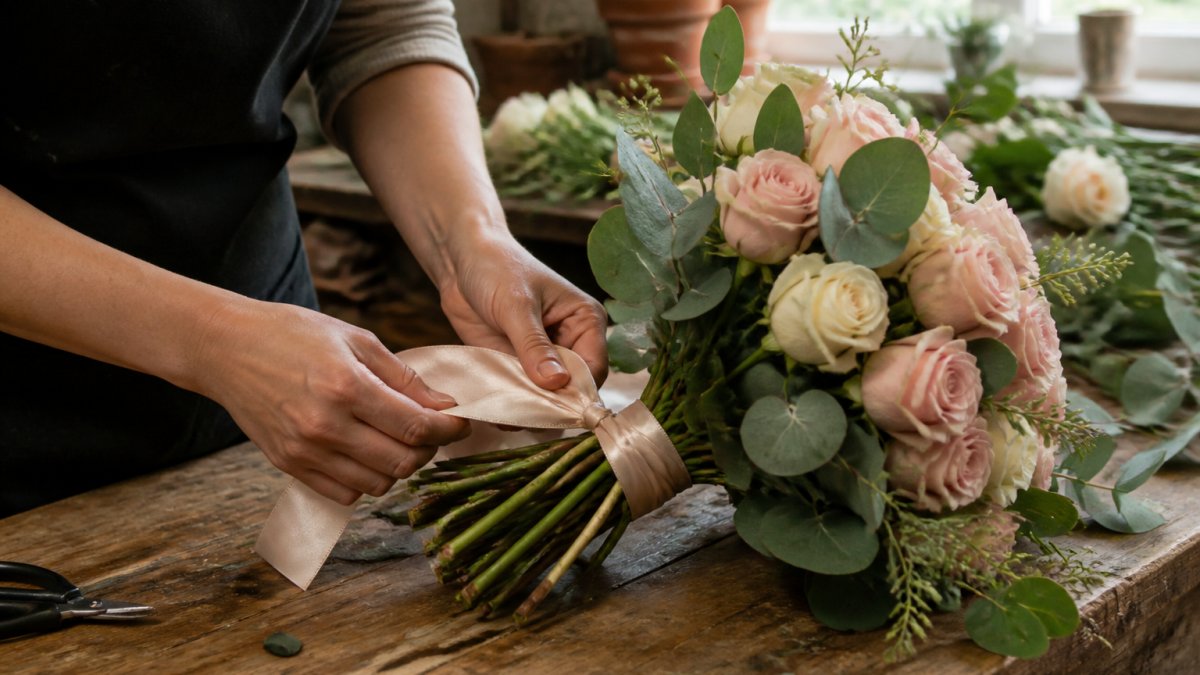
The process has a rhythm to it:
- The florist holds the first stem upright and adds each new stem at the same angle
- Leaves are stripped from the lower half so the water stays clean
- The tie goes at one binding point, keeping the spiral intact
- The wrap and ribbon finish the gift so it can go straight into a vase
The payoff is practical. A well-tied bouquet keeps its shape, and the receiver can drop it into water without rearranging anything. That is the difference between florist-designed bouquets and a loose bunch.
The spiral tie is what makes a hand-tied bouquet hold together. It is a technique, not a style, and it is the single best test of whether a bouquet was truly built by hand.
Why Florist-Designed Bouquets Stand Apart
Florist-designed bouquets stand apart because a person made judgment calls for your specific order, and those calls show. The flowers are chosen for condition that day, the design fits the occasion, and the finish is done by hand.
Three things separate the work:
- Freshness control: a florist rejects tired stems instead of hiding them in the mix
- Occasion fit: sympathy, birthday, and anniversary work each follow different design logic
- Consistency with character: the quality is reliable, but no two bouquets are clones
If you have ordered flowers online and received something that looked nothing like the photo, this is the fix. Ask for a hand designed arrangement built to the occasion, not a stock image reproduced from a warehouse. Memory Lane Florals & Creative Accent builds every bouquet this way, with same-day delivery available seven days a week.
Frequently Asked Questions
What does florist-designed mean?
Florist-designed means a trained florist arranges the bouquet by hand, choosing each stem for color, texture, and form rather than following a pre-set assembly line. The florist balances the flowers, adds greenery, and finishes the wrap or vase so the arrangement looks intentional from every angle. This is different from boxed or mass-market flowers, where identical bunches are packed without individual attention. At Memory Lane Florals & Creative Accent, every bouquet is built by hand to suit the occasion and the recipient.
What makes a bouquet hand-designed?
A bouquet is hand-designed when a florist selects and places each stem individually, adjusting the shape and balance as they go. The florist considers the flower varieties, colors, and textures, then builds the arrangement in their hand or on a workbench instead of using a fixed template. Hand-designed bouquets often include unique accents, varied stem lengths, and a natural flow that machine-bunched flowers lack. The final wrap, ribbon, and card are also finished by hand, giving the gift a personal touch.
How does a florist create a hand-tied bouquet?
A florist starts by gathering the main flowers, then adds secondary blooms and greenery one stem at a time, turning the bunch as they work to keep the shape balanced. Once the arrangement is complete, they tie it securely with twine or ribbon at the binding point, leaving the stems long enough for the recipient to trim and place in a vase. The hand-tied method keeps the bouquet looking natural and allows the flowers to be displayed without re-arranging. This technique is a hallmark of florist-designed bouquets.
How can you tell if a bouquet is professionally arranged?
Professionally arranged bouquets show a clear focal point, balanced color distribution, and a variety of flower shapes and sizes. The stems are clean and cut at an angle, the greenery supports the blooms without overpowering them, and the wrap or vase complements the overall look. You might also notice a consistent style and a card or ribbon finish that feels considered. Hand-designed arrangements often have slight variations between bouquets, which is a sign of individual attention rather than mass production.
Ordering flowers for a birthday, an anniversary, or a service should not feel like a gamble on what arrives. Memory Lane Florals & Creative Accent hand-builds every arrangement, uses fresh blooms chosen that day, and offers same-day delivery across the area seven days a week. Call to order and tell us the occasion. We will design something made for the moment, not pulled from a shelf.


