


Last Updated: October 22, 2026
Quick Summary
To choose a wedding florist Brampton couples should score candidates on style match, communication pace, and venue logistics before comparing price. Book 9 to 12 months ahead for peak-season Saturdays, set your floral budget before requesting quotes, and ask for an itemized quote separating design, labor, delivery, and setup.
- Define your design style as traditional, bohemian, structured, or loose before shortlisting any florist.
- Book 6 months out for off-season or weekday weddings instead of the peak-season window.
- Allocate budget in priority order: personal flowers, ceremony focal point, reception tables, then accents.
- Ask how many weddings the shop takes on the same weekend before you sign.
- Lock the substitution standard, venue access window, and change deadline in writing before paying a deposit.
Table of Contents
- Start With Your Wedding Vision and Floral Design Style
- How to Choose a Wedding Florist in Brampton: A Comparison Framework
- Build Your Wedding Flower Budget Before You Request a Quote
- Your Wedding Florist Booking Timeline, From 12 Months Out
- Wedding Florist Questions to Ask Before You Sign
- Use a Wedding Florist Consultation Checklist
- Seasonality, Substitutions, and Venue Logistics
- Frequently Asked Questions
Start With Your Wedding Vision and Floral Design Style
Your wedding florist Brampton flowers should look like you, not a catalog page. Before you call a single shop, define the look you want, because that decision shapes which florists you shortlist, what you ask in consultations, and how your budget splits across bouquets, centerpieces, and ceremony pieces.
A wedding florist plans, sources, and installs flowers for a ceremony and reception, from the bridal bouquet to the last centerpiece. Choosing the right one is less about the cheapest quote and more about matching design style, communication, and logistics.
Traditional, Bohemian, Structured, or Loose: Naming Your Look
Most wedding floral design falls into four broad families. Knowing which fits your day gives a florist something concrete to work with.
- Traditional: symmetrical, rounded bouquets, classic roses and hydrangea, uniform centerpieces. Formal and timeless.
- Bohemian: wild, trailing greenery, dried elements, asymmetry, and a relaxed silhouette. Suits outdoor and barn venues.
- Structured: architectural, geometric, and modern. Think clean lines, monochromatic palettes, and sculptural ceremony installations.
Most couples land between two of these, which is fine. “Loose with some structure in the centerpieces” tells a designer far more than a folder of screenshots.
Sort your saved inspiration photos into two piles: “must have” and “nice to have.” Bring only the must-haves to your consultation. A florist can design from five strong references; forty mixed ones usually mean the vision hasn’t settled yet.
How to Choose a Wedding Florist in Brampton: A Comparison Framework
The right wedding florist in Brampton matches your style, your communication pace, and your venue logistics. Score every candidate on those three before price enters the conversation.
Rate each florist from 1 to 5 on each row, then compare totals.
| Criterion | What to Look For | Why It Matters |
|---|---|---|
| Portfolio fit | Real weddings in your style, not just shop bouquets | Shows range under event pressure |
| Design style match | Traditional, bohemian, structured, or loose | Fewer revisions, better result |
| Reviews and referrals | Recent couples, venue-specific feedback | Reveals reliability, not just artistry |
| Consultation process | Structured questions, mood board review | Signals organized planning |
| Delivery and setup | Written confirmation of times and scope | Prevents day-of gaps |
| Contract clarity | Deposits, cancellation, change deadlines | Protects both sides |
| Responsiveness | Reply time during the inquiry stage | Predicts communication later |
A florist who scores well on portfolio but poorly on contract clarity is a risk; one who scores moderately on both is usually the safer booking.
Portfolio, Design Style, and Reviews: What to Check First
Start with the portfolio, but read it critically. Look for full wedding galleries rather than single hero shots, and check whether the bouquets, boutonnieres, and centerpieces in one wedding look like they belong together.
Then read reviews for the boring details: did flowers arrive on time, did setup match the plan, did the florist answer questions in the final week.
A portfolio of shop arrangements is not a wedding portfolio. Event work involves scale, timing, and installation that retail bouquets never test. Ask specifically for weddings at or near your venue type before you book.
Build Your Wedding Flower Budget Before You Request a Quote
Set your floral budget before you ask for pricing, not after. Couples who shop quotes first anchor on whatever number arrives and then spend months trimming, far more stressful than designing to a figure.
Decide what share of your overall wedding budget goes to flowers, then split it in priority order: the largest share for pieces photographed all day (bouquet, boutonnieres, ceremony focal point), a middle share for reception tables, and a smaller share for accents like bar, cake, and welcome arrangements.
What Actually Drives the Price
Wedding flowers are priced on inputs, not a flat package rate. The main cost drivers are:
- Stem count and bloom size. Large blooms like hydrangea or peony cost more per stem than smaller flowers and greenery. Ask how many stems are in a sample bouquet to compare like with like.
- Season and sourcing. In-season stems are cheaper and healthier than out-of-season imports. A florist who names what is peaking in your wedding month is quoting more honestly than one who promises any flower at any date.
- Quantity and repetition. Centerpieces are the biggest lever because they multiply by table count. Ten tables at one price per centerpiece is a very different number from twenty.
How to Split a Stated Budget Across Categories
Once you have a total figure, allocate it in priority order rather than evenly:
- Personal flowers first. Bouquet, boutonnieres, corsages, and any flower crowns. These are in almost every photo and hardest to substitute later.
- Ceremony focal point second. The arch, chuppah, or backdrop is the second most photographed element. If the ceremony and reception share a space, plan to reuse ceremony pieces at the reception to stretch the budget.
- Reception tables third. Decide centerpiece count and style together. Fewer, larger centerpieces often cost less than many small ones and read better in photos.
- Accents last. Bar, cake, welcome table, and bathroom arrangements are nice-to-have. Fund them only after the first three are covered.
If the total lands high, trim from the bottom of the list, not the top. Cutting the bouquet to save money is the most visible cut you can make.
Ask for an Itemized Quote
Pricing depends on quantity, stem selection, season, delivery distance, and installation complexity, so no honest florist quotes from a website page. Ask for an itemized quote separating design, labor, delivery, and setup, that lets you cut intelligently and compare two florists on the same basis.
Request an itemized quote, not a lump sum. A quote that separates flowers, labor, delivery, and installation shows you exactly where to trim without losing the pieces you care about most.
Bring your total floral figure to the consultation and ask the florist to show you two versions: one at your number and one about 15 percent lower. Seeing what changes between them tells you more about value than any single quote.
Your Wedding Florist Booking Timeline, From 12 Months Out
Book your wedding florist Brampton 9 to 12 months before the date for peak-season Saturdays, and 6 months out for off-season or weekday events. Popular designers fill their calendars early.
Here is the timeline we recommend for weddings in the region:
| When | What to Do |
|---|---|
| 12 months out | Define your style, set the floral budget, shortlist florists |
| 10-11 months out | Book consultations, compare quotes, sign the contract |
| 6-8 months out | Confirm the floral package and pay the deposit |
| 3-4 months out | Finalize centerpiece counts and ceremony pieces |
| 6-8 weeks out | Confirm venue logistics, delivery windows, setup access |
| 1-2 weeks out | Final headcount, final changes, confirm arrival times |
The final two weeks are where most stress lives. A florist who locks delivery times and setup access early removes most of it.
Wedding Florist Questions to Ask Before You Sign
Ask these before signing anything. The answers reveal how the shop operates when things get busy, exactly when you need them reliable.
- What is included in the quote, and what costs extra?
- How many weddings do you take on the same weekend?
- Who designs the arrangements, and will that person be involved on my date?
Write the answers down. A florist who answers these clearly and without irritation is telling you something important about how the final month will feel.
Use a Wedding Florist Consultation Checklist
A structured consultation gets you a usable quote instead of a vague conversation. Bring the right materials, ask the right questions, and leave with a written summary.
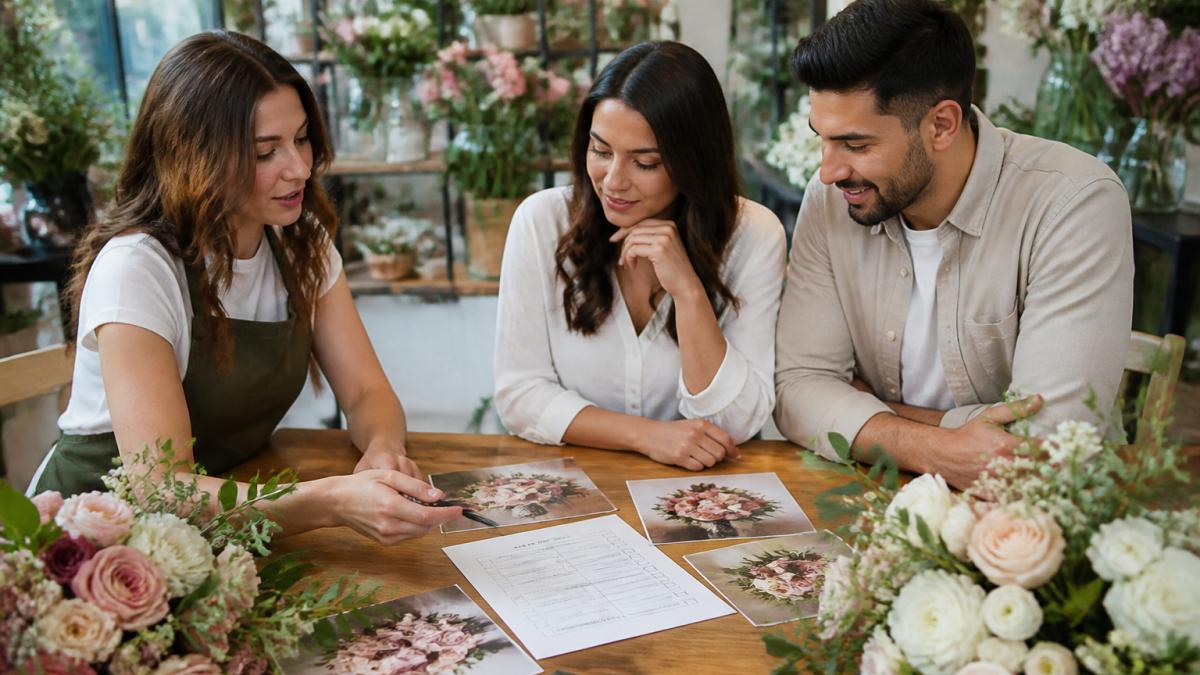
Copy this checklist and bring it to every appointment.
Consultation checklist:
- Wedding date, ceremony time, and reception time confirmed
- Venue name, address, and setup access window noted
- Guest count and table count finalized
What to Bring: Inspiration Photos, Mood Board, and Venue Details
Bring three things: inspiration photos for shapes, a mood board for palette and texture, and venue details for what is physically possible.
Venue details matter more than most couples expect. Ceiling height, load-in access, setup windows, and open-flame rules all change what a florist can build. Tell your designer the venue name and setup window, and ask what they have done there before.
Seasonality, Substitutions, and Venue Logistics
Seasonal flowers cost less and look better. Ask what is at its best during your wedding month and build the palette around those stems. A florist who can name what is peaking, and what is risky, is giving you planning information, not a sales pitch.
How Substitutions Should Work
Substitutions are normal, not a warning sign. Weather, shipping, and grower availability affect every shop; the question is how they are handled. A clear contract states:
- The substitution standard. Replacements should match the original in look, color, and value, not simply fill the same space with a cheaper stem.
- Who approves changes. Small swaps within an agreed palette can usually be left to the designer’s judgment; changes to the main flowers in the bouquet or ceremony piece should be discussed with you first.
- When you will be told. Ask for a heads-up as soon as a substitution is known, not on the morning of the wedding.
Avoid a contract that says nothing at all, or one that gives the florist unlimited discretion with no notice to you.
Venue Logistics and Installation Requirements
Before you book, confirm with the venue and pass to the florist:
- Access window. The exact time the florist can load in and begin setup, and the time the space must be clear.
- Delivery route and parking. Loading dock, service elevator, or stairs, and where the delivery vehicle can stop.
- Setup and teardown scope. Who installs the arch or backdrop, who removes it, and whether teardown happens the same night or the next morning.
Ask the florist what they have done at your venue before, and ask the venue whether they keep a list of experienced vendors. A florist who has worked the room knows its quirks.
Reuse Ceremony Flowers at the Reception
If the ceremony and reception share a space or are close together, plan to move ceremony pieces to the reception: an arch arrangement can become a head-table piece, aisle flowers can become bar arrangements, and large urns can flank the dance floor. Reuse stretches the budget, but only if the florist plans for it from the start, the pieces must be movable, and someone must be responsible for moving them during cocktail hour.
Never pay a deposit without a written contract that names the date, the itemized scope, the delivery and setup terms, the substitution standard, and the cancellation policy. A verbal agreement is not protection when the date is nine months away.
Contract, Payment, Cancellation, and Change Policies
Read the contract before you sign, for four things: the deposit amount and whether it is refundable, the payment schedule, the cancellation terms, and the change deadline.
Ask specifically what happens if you reduce your centerpiece count after the change deadline, and what happens if the wedding date moves. Get the answers in writing. A clear contract protects you and the florist equally, and a shop that resists putting terms in writing is a shop to keep comparing.
Seasonality, substitutions, and venue logistics are where wedding flowers most often go sideways. Lock the substitution standard, the venue access window, and the change deadline in writing before you pay a deposit.
Planning wedding flowers in Brampton comes down to three things: knowing your style, budgeting before you shop, and asking the questions that reveal how a florist operates under pressure. At Memory Lane Florals & Creative Accent, we are a family-owned and operated local florist, voted #1 Best Brampton & Mississauga Florist, offering hand-designed floral arrangements, wedding floral decor and centerpieces, and same-day flower delivery available seven days a week. We would be glad to walk through your wedding vision and put together an itemized quote for your date. Call us to book your consultation and get started.
Frequently Asked Questions
How do I pick a florist for my wedding?
Start with your vision and budget, then shortlist two or three florists whose portfolios match the style you want. Book consultations, bring inspiration photos and venue details, and ask about availability, delivery, setup, and change policies. Compare quotes line by line, not just totals, so you can see what each one includes. A good wedding florist Brampton couples trust will explain substitutions clearly and put everything in writing before you pay a deposit.
What is the 3-5-8 rule for florists?
The 3-5-8 rule is a design guideline, not a pricing formula. It suggests using three sizes of blooms: large focal flowers, medium supporting flowers, and small filler flowers. The mix keeps arrangements balanced and gives them depth. You can mention it during your consultation to describe the look you want, but your florist will adapt it based on seasonal availability and your wedding flower budget.
When should I book a wedding florist?
Book six to twelve months before your wedding date, and earlier for peak spring and summer weekends. Your wedding florist booking timeline should start with a consultation around the twelve-month mark, a signed contract and deposit at nine to ten months, a final flower selection at six to eight weeks, and a confirmed count about two weeks out. Brampton venues fill quickly in wedding season, so earlier is safer.
What questions should I ask a wedding florist during a consultation?
Ask about availability for your date, what the quote includes, delivery and setup fees, whether they have worked at your venue, how they handle seasonal substitutions, and what their contract says about changes and cancellations. Also ask to see a portfolio of full weddings rather than single bouquets. These wedding florist questions to ask reveal how a shop works day to day, which matters more than a pretty sample arrangement.
How can I compare wedding florist quotes?
Put quotes side by side and compare the same items: bridal bouquet, boutonnieres, ceremony flowers, centerpieces, delivery, and setup. Check whether tax, labor, and installation are included or added later. A lower total can cost more once extras appear. Ask each florist to break down pricing by item so you can see where the wedding flower budget actually goes, then choose based on value and fit, not the headline number.


