


Table of Contents
- Why Hand Designed Bouquets Matter More Than You Think
- Hand-Tied Bouquet vs. Arranged Bouquet: What’s the Real Difference?
- The Principles of Flower Arranging That Shape Every Hand-Designed Bouquet
- How a Floral Designer Chooses Stems, Shape, and Color
- Personalized Bouquets for Special Occasions: Birthdays, Anniversaries, and Sympathy
- How to Make a Bouquet Last Longer: Care Tips From the Design Bench
- How to Spot True Craftsmanship When You Buy Hand Designed Bouquets
- Frequently Asked Questions
Last Updated: October 9, 2026
Why Hand Designed Bouquets Matter More Than You Think
A hand designed bouquet is a floral arrangement built bloom by bloom by a person, not assembled on a production line to a fixed template. The difference shows up in how the flowers sit, how the arrangement ages, and how it feels to receive. This guide from Memory Lane Florals & Creative Accent walks through the construction, design principles, and buying signals that separate true handwork from mass-produced lookalikes.
If you have ever ordered flowers online and opened a box that looked nothing like the photo, you already understand the stakes. A machine-assembled bouquet is built for speed and shipping tolerance. A hand-designed one is built for the moment it lands in someone’s hands.
Below, we break down the hand-tied technique, stem selection, shape, color, and the care steps that keep a bouquet looking fresh for days. We also show you exactly what to look for when you buy, so “hand-designed” stops being a marketing word and starts being something you can verify.
Hand design is not decoration. It is the reason a bouquet holds its shape, survives the journey, and looks intentional from every angle, not just the front.
Hand-Tied Bouquet vs. Arranged Bouquet: What’s the Real Difference?
The real difference is the binding point, and everything else follows from it. A hand-tied bouquet is held in one hand and secured at a single binding point, so the stems spiral outward from one spot. An arranged bouquet is typically built in foam or a vessel, with stems pushed in individually. A mass-produced bouquet is assembled to a fixed template, often with foam, glue, or wire holding the shape.
That structural choice changes everything downstream:
- Stability: A single binding point locks every stem against its neighbors, so the bouquet resists shifting in transit. Foam-set stems move independently and can rotate or sink.
- Comfort: The handle stays slim and balanced, which matters when someone holds it through a ceremony or a hospital visit. Foam-based arrangements are heavier at the base and awkward to carry.
- Longevity: Hand-tied stems can be re-trimmed and placed straight into a vase without dismantling the design. Foam holds moisture unevenly, so some stems stay wet while others dry out.
- Hydration path: In a hand-tied bouquet, every stem sits in the same water source and drinks at the same rate. In foam, stems are inserted at different depths, so hydration is inconsistent.
- Airflow: A spiral binding leaves space between stems, which reduces mold and bacterial buildup. Dense foam packing traps moisture against petals.
Hand-designed vs. machine-assembled: a direct comparison
| Factor | Hand-designed | Machine-assembled / mass-produced |
|---|---|---|
| Construction | Spiraled stems, single binding point | Foam, glue, wire, or template jig |
| Customization | Adjusted per recipient, occasion, budget | Fixed recipe, limited variation |
| Appearance | Reads well from multiple angles | Optimized for one front-facing photo |
| Aging | Stems can be re-trimmed and re-vased | Bruises faster, rarely survives a second day out of the box |
| Stem quality | Selected for stiffness and spiral behavior | Selected for shipping tolerance |
| Waste | Minimal wrapping, compostable stems | Foam, plastic, and non-recyclable binders |
Mass-produced bouquets photograph well and travel cheaply. In practice, they bruise faster, hydrate unevenly, and rarely survive a second day out of the box. A hand-designed bouquet is built for the moment it lands in someone’s hands, not for the warehouse it passes through.
The binding point is the tell. If you can find one spot where the stems cross and are tied, you are looking at hand design. If stems disappear into foam, you are looking at assembly.
The Principles of Flower Arranging That Shape Every Hand-Designed Bouquet
Every strong arrangement rests on the same handful of principles: proportion, balance, harmony, rhythm, and negative space. A floral designer uses them the way a writer uses grammar, quietly, so the finished piece simply reads as right.
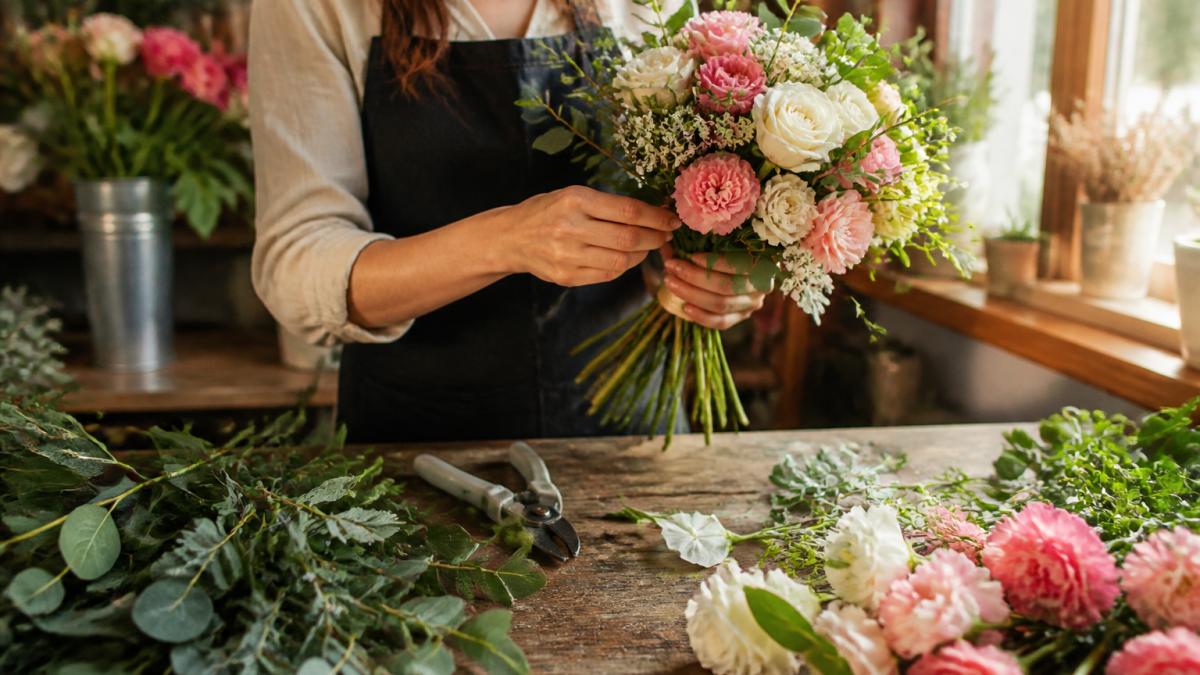
Proportion sets the relationship between the blooms and the vessel or the hand holding them. Balance keeps the visual weight even, so the bouquet does not tip or feel lopsided. Harmony ties color and texture together without competition. Rhythm guides the eye through the arrangement, usually toward one focal flower. Negative space gives individual blooms room to stand out instead of crowding into a solid mass.
The common mistake is treating these as rules to obey. They are tools to bend. A designer working by hand can break proportion deliberately for drama, then correct it with foliage. A template cannot.
How a Floral Designer Chooses Stems, Shape, and Color
Stem selection starts before color. A floral designer picks stems for stiffness, length, and how cleanly they hold a spiral, because a weak stem collapses the whole structure no matter how good the blooms look.
From there, the designer builds the silhouette. Round, loose, cascading, or asymmetrical: the shape should match the occasion and the space where the bouquet will live. A bridal bouquet needs a silhouette that reads well in photographs from every angle. An everyday gift can be looser and more relaxed.
Color and texture come next, layered in threes: a dominant tone, a supporting tone, and an accent. Foliage and greenery do the quiet work, filling gaps, adding movement, and framing the focal flower so it draws the eye without shouting.
Ask your florist which blooms are at their peak this week. Designing around what is freshest, rather than around a fixed photo, is one of the clearest signs you are working with a real designer.
Personalized Bouquets for Special Occasions: Birthdays, Anniversaries, and Sympathy
Personalization is where hand design earns its keep. The same florist who builds a bright birthday bouquet can shift to soft, muted tones for an anniversary and to restrained, respectful arrangements for a sympathy service.
For birthdays, color and playfulness lead. For anniversaries, consider the couple’s palette, a favorite flower, or a bloom tied to a shared memory. For sympathy arrangements, restraint matters more than spectacle: white and green, clean lines, and a shape that suits the funeral home or service setting.
| Occasion | Color Direction | Shape | What to Tell Your Florist |
|---|---|---|---|
| Birthday | Bright, mixed | Round, full | Favorite colors, fun or formal |
| Anniversary | Soft, romantic | Loose, flowing | Shared palette or signature bloom |
| Sympathy | White, green | Structured, calm | Service timing and venue |
| Just because | Any | Compact | Their everyday style |
Budget shapes the design too, and it should. A skilled designer works to your number rather than pushing you past it. Because pricing depends on stem choice, quantity, and delivery, the honest move is to ask for a quote based on what you want. Current pricing is always available on our site or by phone.
How to Make a Bouquet Last Longer: Care Tips From the Design Bench
A hand-tied bouquet lasts longest when you treat the stems, not just the blooms. Fresh flowers are living material, and most premature wilting traces back to the cut and the water, not the design.
- Re-trim each stem at a 45-degree angle with a sharp blade, never scissors that crush
- Strip any leaves that would sit below the waterline
- Use a clean vase with cool water and the flower food provided
- Change the water every two days and re-trim at the same time
- Keep the bouquet out of direct sun, drafts, and ripening fruit
- Handle by the binding point, not the blooms, to avoid petal bruising
Petal bruising is the quiet killer. Every time someone grips a bouquet by the flower heads, oils and pressure damage the petals, and the damage shows up a day later. Teach the recipient to hold the handle.
Never leave a hand-tied bouquet sitting dry in its wrapping overnight. Once the binding point dries out, the stems stiffen and the spiral locks, making it far harder to rehydrate the next morning.
How to Spot True Craftsmanship When You Buy Hand Designed Bouquets
True craftsmanship shows up in small, checkable details. You do not need to be a florist to evaluate it, and you should not have to take the label on faith. The following criteria let you assess a bouquet in under a minute, whether you are standing in a shop or unpacking a delivery.
Inspect the binding point. Turn the bouquet over. A hand-designed piece has one clear spot where the stems cross and are tied. You should see a spiral pattern at the base, with stems fanning from a single point.
Check stem placement. Look for consistent height and spacing. No bloom should be buried under foliage or floating above the rest. Foliage should frame the focal flowers rather than fill gaps.
Test the weight and balance. Hold the bouquet at the binding point. The weight should sit low and centered, not top-heavy. A balanced bouquet feels comfortable to carry for several minutes, which matters for ceremonies, photos, and hospital visits.
Look at the back and sides. A hand-designed bouquet reads well from every angle because the designer rotated it as they worked. A mass-produced one is usually flat at the back, optimized for a single front-facing photograph.
Ask about sourcing and seasonality. This is where hand design and sustainability overlap, and it is a gap most buying guides skip. A designer who works by hand can tell you which blooms are at their peak locally this week, which varieties traveled less, and which wrapping can be composted or reused.
Request care instructions. Hand-designed bouquets tend to arrive with care guidance because the designer expects the arrangement to be maintained, not discarded. If a florist cannot tell you how the bouquet was built or how to keep it alive, that tells you something too.
A quick evaluation checklist
- Single binding point with a visible spiral at the base
- No foam, glue, or wire holding the shape
- Consistent bloom height and spacing
- Foliage framing, not filling
- Reads well from the back and sides
- Weight sits low and balanced in the hand
- Florist can name the season and source of the blooms
- Wrapping is reusable, recyclable, or compostable
- Care instructions included
At Memory Lane Florals & Creative Accent, every arrangement is built by hand with the freshest blooms available, backed by same-day delivery seven days a week. For a deeper look at what goes into fresh, well-kept flowers, the Canadian Food Inspection Agency guidance on fresh cut flowers offers useful context on how fresh material is handled and graded, and the Royal Horticultural Society’s guide to cut flower care explains why clean cuts and cool water extend vase life.
Frequently Asked Questions
What makes a hand-designed bouquet different from a standard arrangement?
A hand-designed bouquet is built bloom by bloom around a binding point, so the designer controls balance, color rhythm, and how the flowers sit from every angle. Standard arrangements are often assembled to a template or pre-formed shape. The hand-built method lets the designer pick each stem for freshness and position, which usually means better structure, less petal bruising, and a bouquet that still looks intentional days later.
Are hand-designed bouquets suitable for birthdays, anniversaries, and sympathy occasions?
Yes, and the design should change with the occasion. Birthdays suit bright, loose, textured bouquets; anniversaries often call for roses or seasonal blooms in a tighter, romantic silhouette; sympathy arrangements usually favor soft whites, greens, and calm shapes. A florist can adjust color, size, and formality to match the recipient and the message, which is hard to do with mass-produced options.
How can you make a hand-designed bouquet last longer?
Trim the stems at an angle with a sharp knife, remove any leaves below the water line, and change the water every two days. Keep the bouquet out of direct sun and away from heating vents or fruit bowls. A clean vase matters too: wash it with soap before use. These steps slow bacteria growth and keep the stems drinking, which extends vase life noticeably.
Is a hand-tied bouquet better than a vase arrangement?
It depends on the moment. A hand-tied bouquet is ideal for gifting because the recipient can place it straight into their own vase, and the binding point keeps the shape intact during delivery. A vase arrangement is ready to display immediately, which suits hospital visits, offices, or sympathy deliveries where no one wants to hunt for a container. Both can be hand-designed; the difference is presentation, not craftsmanship.


